

Recent headlines have raised fears that advanced AI could grow too capable for humanity to control. That risk deserves attention. But another problem is already here: organizations are becoming dependent on AI systems they cannot operate, evaluate, or replace on their own.
In June 2025, Anthropic gave AI coding company Windsurf less than a week’s notice that it was cutting off nearly all of the company’s direct access to its Claude 3.x models (Claude 3.5 Sonnet, 3.7 Sonnet, and 3.7 Sonnet Thinking). At the time, OpenAI was reportedly seeking to acquire Windsurf.
Windsurf said it was willing to keep paying, but that did not matter. Other providers could not immediately supply enough capacity, and so Windsurf had to remove direct Claude access from free and trial accounts and warn users to expect availability problems.
Windsurf had over 800,000 active developers, paying customers, and a working product. But it did not control access to the technology at the heart of that product.
Access to AI is not control. A supplier can change the terms, restrict access, raise prices, or withdraw a model altogether.
AI Sovereignty Is Not Just for Countries
Control over AI is both a commercial concern and a source of geopolitical power.
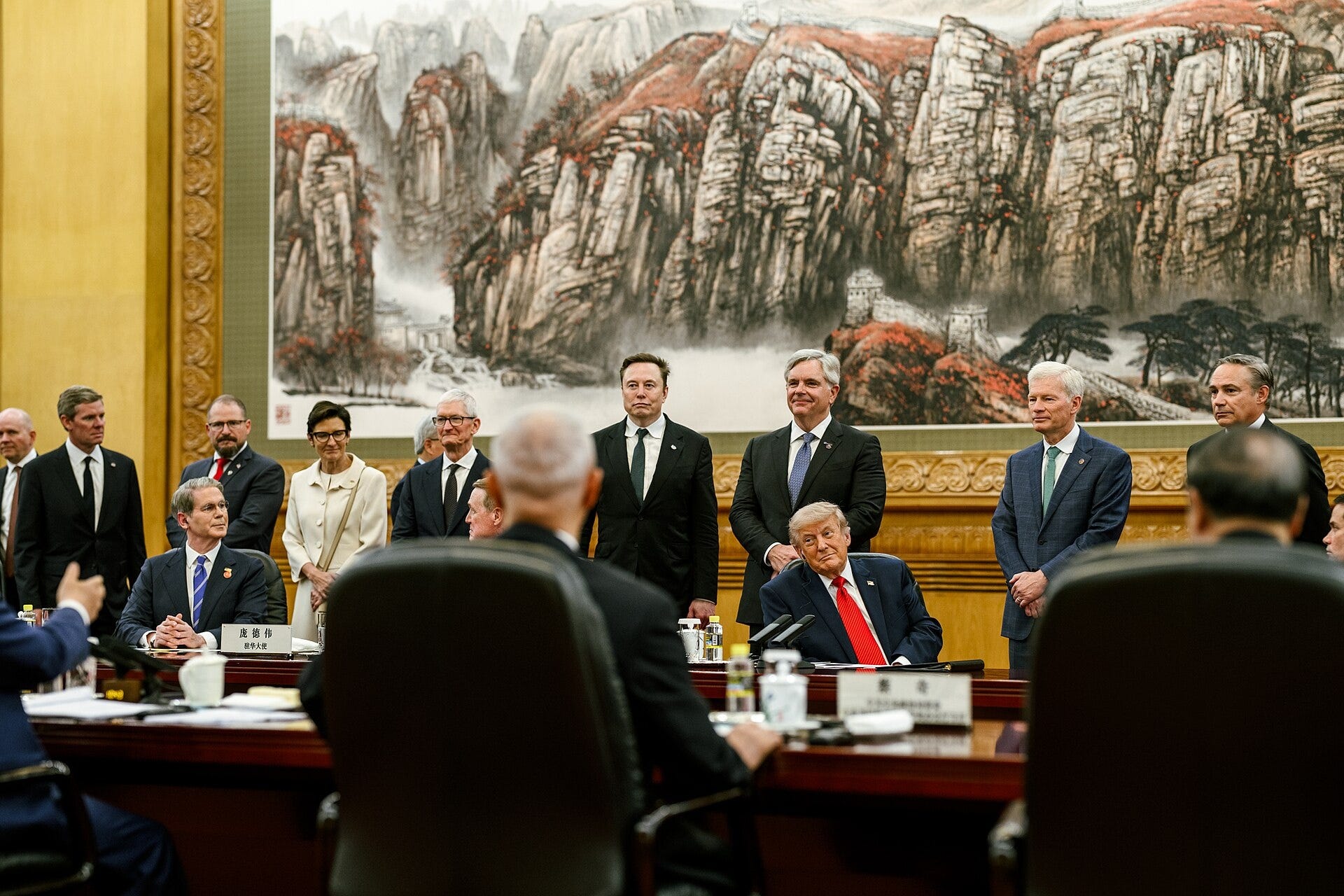
President Donald Trump meets with Chinese President Xi Jinping and a delegation of American CEOs, May 14, 2026. Photo: The White House, public domain, via Wikimedia Commons.
When President Donald Trump and President Xi Jinping meet this week, AI will be high on the agenda. The United States has proposed an AI safety notification mechanism, with China’s response unclear. The leaders are also expected to take up AI safety and technological competition.
At the center of these discussions is AI sovereignty. Can a country build and operate AI on its own terms, or must it depend on foreign technology?
Countries are not the only ones facing this question. Inside the U.S., universities, hospitals, laboratories, law firms, businesses, and government agencies must also decide how much control they require over the AI they use.
This means thinking about sovereignty in decentralized terms. Decentralized AI sovereignty distributes the practical ability to build, operate, evaluate, and change AI across independent institutions. For any one organization, sovereignty means being able to make consequential choices about the AI systems it uses.
This does not require every organization to build a frontier model from scratch. It means having enough technology and expertise to decide where its data go, evaluate how a system performs, and modify or replace that system when necessary.
An organization might run a model internally, maintain its own applications and knowledge stores, or use a hybrid system that determines which tasks and information may leave the organization.
Open-weight models help make this possible by allowing organizations to run and adapt model parameters locally rather than sending every input to the original developer.
In practical terms, a firm can take an existing model and run it on computers it controls. Its own team decides what information the model can use, checks whether it does the job well, and can replace it if a better option becomes available.
Hardware, licenses, and skilled personnel still matter. The goal is not complete independence, but the ability to choose.
What Organizations Can Do
Some organizations are already moving in this direction. Latham & Watkins, one of the world’s largest law firms, has bought its own Nvidia chips and is using them to adapt open-weight models on servers accessible only to its employees. The firm still uses commercial AI products, but its own infrastructure allows it to protect sensitive information and build tools around its lawyers’ expertise.
Thomson Reuters, the company behind Reuters and Westlaw, has taken a similar approach. It invested $40 million to train Thomson using an existing open-source model as a starting point and training it with the company’s content and professional expertise. Rather than relying entirely on outside providers, Thomson Reuters now owns and controls the model itself.
Neither organization is withdrawing from the broader AI ecosystem. Both still depend on outside models, chips, software, and expertise. But they have created room to act: to protect confidential information, assess whether a model meets their needs, and change course when necessary.
Domestic Dependence Is Still Dependence
The Trump administration is also pursuing greater technological independence. Its AI Action Plan calls for more domestic infrastructure, support for open-weight models, and wider AI adoption.
At the same time, the federal government is directing major AI contracts to a small group of large companies. In 2025, the Defense Department awarded separate contracts valued at up to $200 million each to Anthropic, Google, OpenAI, and xAI.
Powerful American AI companies do not by themselves make America technologically sovereign. If its universities, hospitals, businesses, and government agencies all rely on systems controlled by the same few providers, the country remains dependent. The dependence just moved inside the borders.
Why Organizations Need Their Own AI Expertise
Dependence on a few firms also creates a problem of oversight. In my previous post, “Who Governs Our Biological Future?” I wrote about governments’ growing reliance on private technology companies for advanced capabilities and the expertise needed to understand them. Industry must be part of governance because its knowledge is indispensable. But it cannot provide independent oversight of itself.
Independent oversight requires independent expertise. Organizations with their own AI capacity are better positioned to evaluate commercial systems, contribute evidence to public debates, and protect confidential information.
This is especially important in biology. A research laboratory may need to protect unpublished experiments, patient information, genetic data, or knowledge with security implications. It must also be able to assess an AI system using its own scientific expertise rather than relying entirely on the developer’s assurances.
Government agencies face a similar problem. If they depend on the same companies both for AI systems and for the expertise needed to evaluate them, they may struggle to question the claims those companies make. Distributing AI knowledge across universities, laboratories, public agencies, and other organizations would create more independent sources of technical judgment.
Giving organizations more control over AI does not guarantee that they will use it responsibly. They still need oversight. But that oversight will be weak if governments and other institutions must rely on the same companies for the expertise needed to evaluate them.

The Frontier supercomputer at Oak Ridge National Laboratory, June 1, 2022. Photo: OLCF at ORNL, CC BY 2.0, via Wikimedia Commons.
Control Does Not Mean Going It Alone
Greater control need not prevent cooperation. MELLODDY, a research consortium involving ten pharmaceutical companies, jointly trained drug-discovery models while allowing each company to retain control of its underlying data. The participants could learn collectively without placing their proprietary datasets in a common repository.
The international biosecurity initiative SecureDNA offers another example. Developed by researchers in the United States, China, Europe, and Israel, the system screens DNA orders for controlled sequences associated with biological threats while protecting customers’ sequence information. It was tested on 67 million nucleotides synthesized by providers in the United States, Europe, and China. SecureDNA shows how institutions can cooperate on a common security system without requiring them to surrender sensitive data.
Organizations can cooperate without giving up control of sensitive data. They can share expertise, set common standards, and coordinate security while protecting their own information. Decentralized AI sovereignty will not solve every problem. Organizations still need oversight, and open-weight models still depend on hardware, energy, licenses, and skilled workers. But spreading AI capacity gives more institutions a voice and reduces their dependence on a few suppliers. It can also encourage cooperation by allowing organizations to work together without compromising their data or independence.
The Road to Real AI Sovereignty
America will not achieve AI sovereignty by replacing dependence on China with dependence on a few American companies. Real sovereignty requires giving organizations meaningful control over the AI systems on which they rely. National sovereignty begins with organizational control.