

In 1957, at the height of the Cold War, twenty-two scientists from ten countries gathered in the small Canadian fishing village of Pugwash. Several had helped develop the world’s first atomic weapons. Now they were confronting the possibility that humanity was losing control of the technologies they had helped create.
What began in Pugwash became a decades-long movement. Scientists crossed geopolitical divides, developed relationships with their counterparts, and worked through technical problems that governments could not resolve on their own. Their conversations helped lay the intellectual foundations for nuclear arms-control agreements, including the 1963 Limited Test Ban Treaty, which prohibited nuclear testing in the atmosphere, outer space, and underwater.
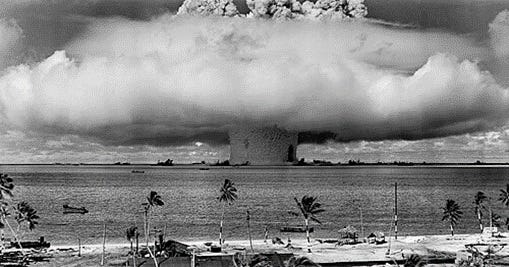
“Baker” nuclear test, Bikini Atoll, 1946. U.S. Department of Defense/Wikimedia Commons (public domain).
Today, we face a different technological danger: the convergence of artificial intelligence and biotechnology. AI may dramatically lower the barriers to creating biological weapons. In June, leading AI companies sent Congress an open letter warning that increasingly capable models could make specialized biological knowledge more accessible to bad actors, and called for tighter screening of synthetic DNA and RNA orders. However, the international institutions meant to manage biological threats are weak, geopolitical rivalry is intensifying, and governments are struggling to keep pace with new developments.
In our article, Sophie and I argue that this moment calls for a new version of the Pugwash model. We need a sustained, international forum to bring together scientists, technologists, and ethicists to address catastrophic biological risks.
This would be in addition to formal diplomacy. Scientists cannot resolve geopolitical conflicts. But they can build the trust and shared knowledge that make government action possible when a political opening arises.
A contemporary Pugwash would also need to reflect an important difference between the nuclear age and our own. Governments once funded and controlled most of the technologies with major national-security implications. Today, much of the most consequential research in AI and biotechnology takes place in private companies. Industry expertise is indispensable, but commercial interests could also compromise the independence of any effort designed to govern these technologies.
Several track-two initiatives already promote U.S.-China dialogue on military AI and biotechnology, while others focus on Southeast Asia and the U.S.-India partnership. These efforts remain largely bilateral or regional. The global accessibility of AI-enabled biological weapons demands broader geographic participation and sustained engagement with the scientists and engineers driving technological change.
The history of Pugwash suggests that progress sometimes begins quietly, with scientists meeting across state lines and doing the patient work required to make cooperation possible.
Read “Scientists Saved Us from Catastrophic Risk Before” in Foreign Policy.
To learn more about Pugwash, I recommend this Science History Podcast interview with John Holdren. Holdren served as President Barack Obama’s science advisor from 2009 to 2017 and chaired Pugwash’s executive committee from 1987 to 1997. When Pugwash received the Nobel Peace Prize in 1995, he delivered its acceptance lecture.