

The U.S.-China technology race absorbs much of the world’s attention. There is a third contender for global influence, however. India is the world’s most populous and fastest-growing economy (and fifth largest at current exchange rates, poised to overtake Japan and Germany in coming years). Its Viksit Bharat 2047 (“Developed India by 2047”) vision aims to make the country’s economy “strong, inclusive, and full of job and entrepreneurial opportunities” by the 100th anniversary of its independence. Part of that ambition is for India to be “among the top three AI superpowers globally” and a “responsible AI leader for the world.”
How does India’s vision of technological leadership differ from those of the United States and China? What role does biotechnology play, and what could India realistically achieve by 2047?
The United States is promoting exports of its full-stack AI technology package, from chips to models to applications. China is pursuing an “AI Capacity-Building Plan for Good and for All” for countries in the Global South, offering cooperation on infrastructure, training, and AI safety.
India has fewer resources to compete at the frontier, but it has strong ties across the Global South and a long tradition of preserving its independence from major powers. Its legacy of nonalignment gives it a familiar role: bringing countries together without asking them to choose a side. At its AI Impact Summit in February, India called for AI to be “equitably shared across humanity.” Under India’s chairship this year, BRICS leaders welcomed “deepening of cooperation in global health initiatives” and “advancing universal health coverage.” This month’s BRICS summit, as South Asia analyst Michael Kugelman observes, “provided India with “an opportunity to showcase its convening power and reassert its global leadership… amid rising discontent with the Western-led global order.”
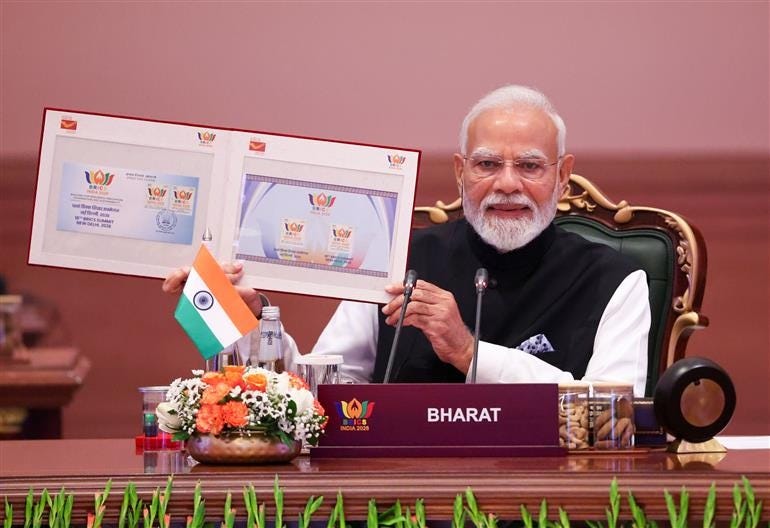
Prime Minister Narendra Modi at the BRICS summit in New Delhi, September 12, 2026. Photo: Press Information Bureau/Prime Minister’s Office, Government of India, via Wikimedia Commons
Biotechnology offers a practical test of that ambition. India is already a major force in vaccine manufacturing and global supply. Its government has estimated that Indian manufacturers account for some 60 percent of global vaccine production. In February, the World Health Organization approved a polio vaccine made by India’s Biological E. using technology transferred from Indonesia’s Bio Farma. The partnership added another source of vaccine supply for countries responding to outbreaks. At home, India’s BioE3 policy is building shared biofoundries and manufacturing facilities that smaller firms and university researchers can use. Through efforts such as the BRICS Vaccine Research and Development Centre, India could help other countries train scientists and manufacture them closer to where they are needed. That would help more of the world prepare for the next outbreak.
Last week, I had the honor of delivering a keynote at the Viksit Bharat conference hosted by Government College for Women, Nawakadal, in Srinagar. I spoke about how India could turn its growing strength in biotechnology and AI into wider opportunity at home and a different kind of leadership abroad. The research projects presented at the conference showed what that ambition means in daily life.
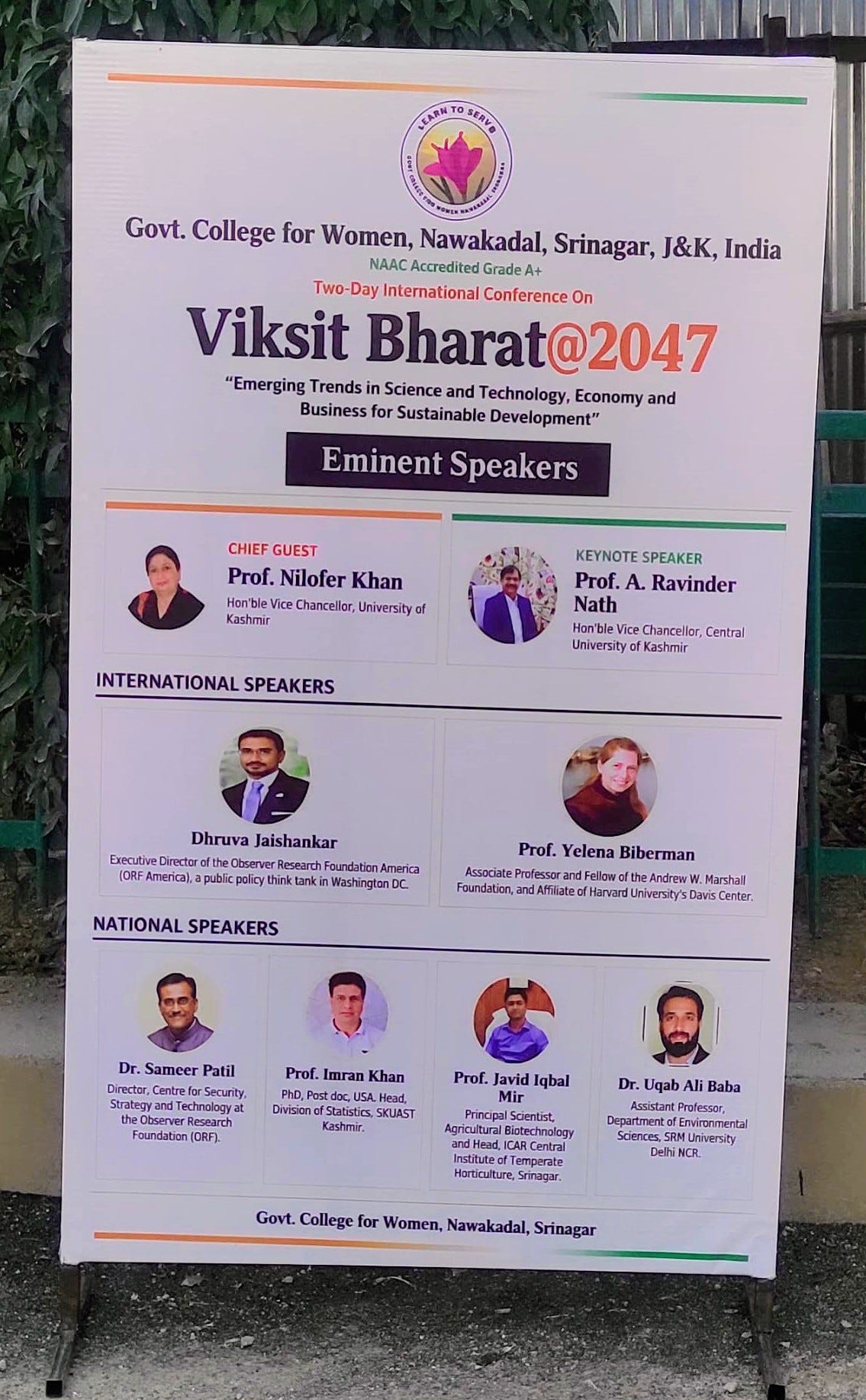
Photo courtesy of Samir Ahmad, September 24, 2026
One project surveyed 950 rural households across 20 districts of Jammu and Kashmir to ask whether piped drinking water changes a woman’s life. The researchers found that access can ease women’s daily burdens and improve household wellbeing, but lasting gains depend on reliable service and on women having a voice in local water decisions. Another study, a survey of more than a thousand women in Srinagar, Anantnag, and Baramulla, found that education and skills are strongly associated with whether a woman participates in the job market. However, only about one in four of the women surveyed was in the job market at all, and only about one in seven said she had a say in whether she could work.
In both cases, the resource is there, but the benefit depends on whether it is actually accessible. The same is true of technology. A new vaccine does little good if it cannot reach the people who need it.
So, what is realistic for India? Vaccine manufacturing and sharing know-how with other countries are within reach now. Racing the United States and China to the frontier of AI is not. But India’s real test is not how fast it builds new technology. It is how widely it can share it, and whether ordinary people, at home and abroad, can use it to live better.